From Burden to Benefit: How to Accumulate Institutional Intelligence from Government Investigations
Author: LDI Team
When a government subpoena or Civil Investigative Demand (CID) lands on a corporate desk, business as usual suddenly ceases. After the initial panic fades, legal teams make an all-hands-on-deck effort to clear the investigation.
As they scramble to preserve, collect, respond, and contain, the instinct to prevail makes it easy to treat the investigation as a discrete event rather than a structured input into how the next one can be addressed more effectively and efficiently.
Each matter generates a body of operational, technical, and relational knowledge that would be treated as a strategic asset in any other context. In practice, this knowledge tends to dissipate when a matter closes. The case team rotates, internal and vendor relationships lapse, and key insights about privilege call patterns, technology assets, and agency-specific intelligence walk out the door with the people who held them. The next investigation must therefore re-answer questions that were previously resolved — not from negligence, but from the absence of any architecture designed to capture and carry forward what the prior matter produced.
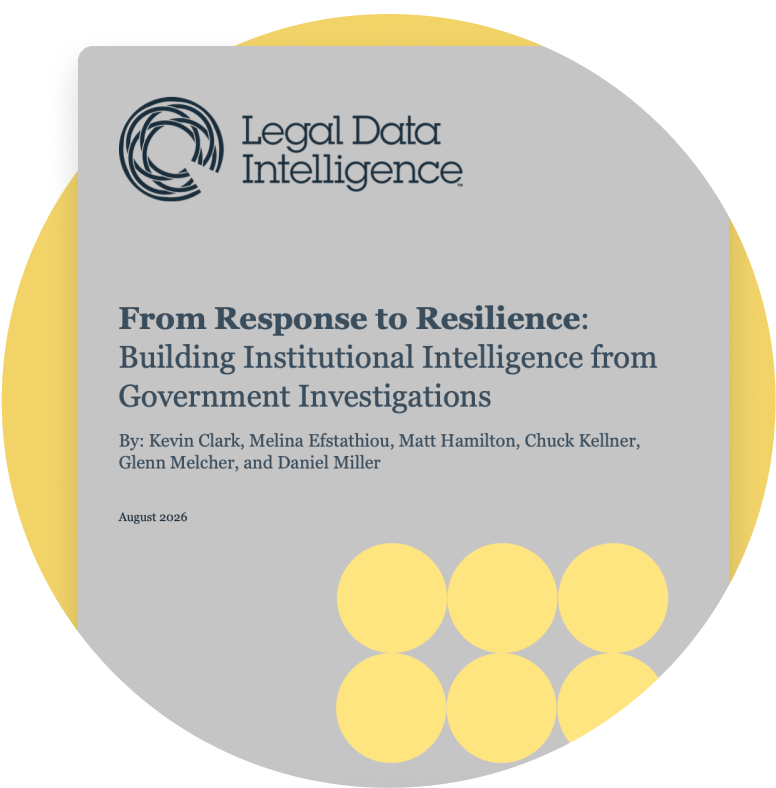
Guide
From Response to Resilience: Building Institutional Intelligence from Government Investigations
Get the GuideWithout a commitment to memorialize the learnings acquired over the course of the matter, the organization misses the opportunity to generate value that will survive it. Considerable costs and burdens are incurred during each government investigation — from the impact on business clients and partners, the time and costs of outside counsel, and the involvement of senior executives and board members. By evaluating metrics and accumulating knowledge associated with the investigation, the organization can derive long-term benefits in how it handles future legal proceedings.
Last year, LDI Architects published a white paper, "The Application of Legal Data Intelligence to Governmental Investigations". While the white paper addressed how to apply LDI within a given investigation, a new guide advances the concept, identifying the significance of what happens between investigations.
In "From Response to Resilience: Building Institutional Intelligence from Government Investigations," the LDI Architects make the case that building institutional intelligence does not require additional headcount or the allocation of significant new investment. Instead, they show how institutional intelligence is captured and accumulated by a governance mindset that is applied from day one of each and every matter: decisions recorded, not just made; variances logged, not just employed; negotiation outcomes annotated with the reasoning that produced them.
The guide turns this principle into a working method, walking readers through the full arc of a matter, showing exactly where the knowledge worth keeping is produced and how to capture it before the knowledge is lost. It organizes the discipline around three stages of the matter lifecycle. At initiation, the categories of decisions worth recording are identified. Throughout the investigation, those decisions and the reasoning behind them are logged contemporaneously in a matter log and a live burden log. At implementation, a structured debrief extracts what the investigation revealed before the team disperses. The guide then shows how the outputs of that process — namely a scope and negotiation record, a burden baseline, a privilege baseline, and an agency profile — consolidate into a living government investigation playbook that the next team can draw on immediately. It demonstrates how that same accumulated knowledge equips an organization to engage regulators proactively and feed what its investigations reveal back into its compliance program.
The piece also highlights what changes from one jurisdiction to the next and what stays the same, so that teams facing the Department of Justice (DOJ), the Securities and Exchange Commission (SEC), the UK's Serious Fraud Office (SFO), Financial Conduct Authority (FCA), or the European Commission can adapt the same method to the distinct agency involved.
Ultimately, the organizations best positioned to address their next government investigation are those that treated the last one as a structured learning event.
Read the guide here.